
An MCU that powers an evaluation board is not automatically the right MCU for production. The production decision must match the application’s firmware, I/O, memory, power, package, test method, lifecycle and supply controls. Changing any one of those after layout release can add firmware porting, PCB spins and requalification time.
This guide gives engineering and purchasing teams one workflow: define the system requirement, compare technically compatible MCUs, issue an MPN-level RFQ, validate samples on the actual board, then release only documented alternates for production.
What “production-ready MCU” means
A microcontroller combines a processing core, on-chip Flash and SRAM, clocks, reset circuitry and peripherals such as GPIO, timers, ADCs and serial interfaces. It is not enough to compare clock frequency or Flash size. Two parts with the same Arm Cortex-M core can still require different startup code, register drivers, pin assignments, programming tools and PCB footprints.
| Selection area | Questions to freeze before sourcing | Why it changes the purchase decision |
|---|---|---|
| Firmware platform | Core, instruction set, SDK, compiler, debug interface, bootloader | Controls porting effort and production-programming method |
| Memory | Flash, SRAM, EEPROM/data Flash, external-memory interface | Determines code space, buffers, update method and headroom |
| Peripherals | GPIO, ADC/DAC, timers/PWM, CAN/LIN, USB, Ethernet, SPI/I²C/UART | A missing peripheral is not a purchasing substitute—it can require a redesign |
| Electrical | Voltage, clock source, current, reset/brownout behavior, temperature | Affects power tree, startup reliability and environmental suitability |
| Physical | Package, pitch, pinout, moisture sensitivity, assembly/test access | Affects layout, yield, inspection and programming fixtures |
| Supply | Lifecycle, PCN/PDN, authorized source, date code, lot traceability | Protects continuity and counterfeit control |
1. Start with architecture, memory and real firmware headroom
Specify the application first: deterministic control, low-power sensing, motor control, human-machine interface, gateway, safety monitor or connected device. Then select the MCU family and exact device.
Core and software compatibility
- State the core and architecture required by the released firmware: for example, an 8-bit MCU, a proprietary 16-bit architecture or a named Cortex-M class. The Arm core alone does not make vendor devices software-compatible.
- Confirm the compiler, IDE, SDK, middleware, RTOS and debugger/probe used by the project. Record the supported production programmer and any bootloader protocol.
- Check the latest datasheet, reference manual and errata for the exact ordering code. Peripheral register differences and errata can invalidate a “same-family” replacement.
- Freeze the clock source: internal oscillator tolerance, external crystal/resonator requirements, PLL limits and clock failure behavior. Do not assume an external crystal footprint transfers between vendors.
Flash, SRAM and non-volatile data
List code image size, RAM peak, stack, heap, communications buffers, calibration storage and firmware-update reserve separately. Build margin into the released memory budget rather than sourcing the smallest nominal density.
- Embedded Flash is normally used for program storage; check erase/program granularity, write/erase endurance, retention conditions, boot-region protection and in-application programming requirements.
- SRAM capacity must cover worst-case buffers and interrupt/RTOS overhead. “More Flash” does not compensate for insufficient SRAM.
- If the application writes calibration or logs frequently, identify whether the device provides EEPROM/data Flash or whether an external Serial EEPROM/Flash is required. The number of writes, data retention and power-loss behavior must be tested for the exact MPN.
- External QSPI/OSPI Flash or SDRAM is an architecture decision, not an MCU drop-in substitute; it adds boot, routing, driver and validation work.
2. Match peripherals and connectivity to the actual board
Create a pin-and-peripheral matrix before asking for quotes. Count required signals plus reserved pins for programming, test, reset, crystal, future changes and analog isolation.
Peripherals that need an exact check
- GPIO and interrupts: available pin count, 5 V tolerance where needed, drive strength, wake-up pins and interrupt routing.
- Analog: ADC resolution, effective sampling rate, reference options, input range, channel count, comparator/DAC needs and analog layout constraints. Do not select by resolution alone.
- Control: timer count, PWM channels, complementary outputs, dead-time insertion, encoder/capture inputs and fault shutdown for motor or power applications.
- Interfaces: UART, I²C, SPI, CAN/CAN FD, LIN, USB, Ethernet or other interfaces—include channel count, pin multiplexing and PHY/transceiver dependencies.
- Wireless and security: an MCU does not automatically include Wi-Fi, Bluetooth or a secure element. State whether a separate radio, hardware crypto, secure boot, key storage, debug lock or tamper feature is required.
The pin map must be reviewed alongside the package. A 64-pin device and a 100-pin device in the same family may change power pins, analog pins or peripheral routing enough to require a new layout.
3. Qualify power, temperature, package and manufacturing fit
Electrical and environmental requirements
Specify the allowed operating-voltage range, I/O logic levels, expected current in run/sleep modes, brownout/reset thresholds and startup sequencing. Measure peak current on the actual workload; a typical datasheet number is not a system power budget.
Select the appropriate commercial, industrial or automotive temperature range. AEC-Q100 should be requested only for an automotive program whose qualification plan requires it; it is not a generic replacement for RoHS/REACH declarations or supplier quality records.
Package and assembly review
| Package family | Production implication |
|---|---|
| LQFP/TQFP | Visible leads can simplify optical inspection and rework; confirm pitch and board area. |
| QFN/DFN | Compact and thermally effective, but the exposed pad and bottom terminations require an appropriate land pattern and solder-process control. |
| BGA | High I/O density; requires escape routing and typically X-ray-capable inspection/rework control. |
| WLCSP/PoP | Very small form factor; requires tight PCB fabrication, assembly capability and controlled handling. |
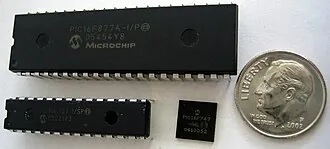
For every candidate, obtain the package drawing, land pattern, moisture-sensitivity level, reflow profile guidance, packing format and reel quantity. Validate that the contract manufacturer can inspect, program and rework the actual package—not merely a similar one.
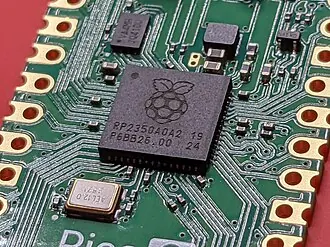
4. Treat lifecycle, security and approved alternates as controlled engineering work
Lifecycle risk starts before a part becomes obsolete. Ask the manufacturer or authorized channel for lifecycle status, announced longevity program where available, PCN/PDN policy, factory/date-code information and authorization evidence. A distributor’s stock statement is not a lifecycle guarantee.
Security and programming controls
- Define firmware image ownership, programming format, serial-number or key provisioning, read-out protection and debug-lock policy before contracting a programming house.
- Validate secure boot, crypto, key storage and tamper features on the actual device if the product uses them. Feature names alone do not prove the desired threat model.
- Record whether programming uses SWD, JTAG, UPDI, a vendor protocol or a ROM bootloader, and reserve programming/test pads in the PCB and fixture design.
- Agree the response to a suspected clone, remark, mixed lot, unauthorized substitution or PCN. Quarantine and engineering disposition should be written into incoming quality control.
When is an alternate MCU really approved?
An “equivalent” alternate needs more than matching core frequency, Flash and package. It requires a documented review of pinout, startup code, peripheral registers, errata, analog behavior, timing, EMC, boot/programming path, toolchain and temperature performance. Freeze an approved-alternate list with an owner and a requalification trigger; do not let a spot quote create a production change.
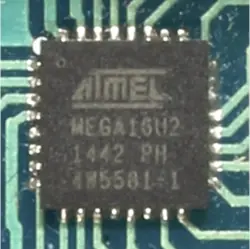
5. Issue an MPN-level production RFQ
Do not request “an STM32-class MCU” or “a 32-bit replacement.” Issue the RFQ against an exact manufacturer part number and requirements table.
| RFQ field | Required detail |
|---|---|
| Identity | Exact MPN, manufacturer, ordering suffix, datasheet/reference-manual revision |
| Firmware fit | Core, Flash/SRAM, boot method, debug/programming interface, toolchain/SDK and required security configuration |
| Peripheral fit | Pinout/package, GPIO, analog, timer/PWM, communications interfaces, clock source and any external PHY/radio dependency |
| Electrical/environmental | Supply and I/O voltage, speed grade, reset behavior, temperature grade, current constraints and EMC/ESD requirements |
| Manufacturing | Package, pitch, MSL, packing/reel quantity, programming image and fixture/test-pad requirements |
| Quality/compliance | Lifecycle status, PCN/PDN, date-code window, lot traceability, CoC, RoHS/REACH; AEC-Q100 only when applicable |
| Commercial | Authorized channel, MOQ, lead time, price basis, allocation, NCNR terms, sample quantity and warranty/returns process |
| Alternatives | Approved alternate MPNs, change-control owner, sample/requalification plan and written approval boundary |
Avoid a capacity-versus-quantity error: “256 KB Flash” describes the MCU, while MOQ and purchase quantity describe the order. Your buffer stock should be based on forecast, lead time, lifecycle risk, storage/handling constraints and cash exposure.
6. Validate samples before production release
- Document and source review: match the quote, full suffix, datasheet revision, lifecycle declaration, PCN/PDN terms, authorization route and country of origin against the RFQ.
- Physical inspection: review labels, date/lot codes, package markings, moisture-barrier bag, reel labels, packing condition, CoC and traceability. Retain reference samples and photographs.
- Board bring-up: program the production image, verify reset/clock/boot, exercise the selected debug path, and confirm all rails across cold and warm starts.
- Functional verification: test every required peripheral and pin mux on the target PCB—analog accuracy, timers/PWM, communications, external memory, security and low-power modes included.
- Margin and reliability testing: run voltage, temperature and clock-margin tests; check watchdog/brownout recovery, power interruption, firmware update recovery, endurance needs and long-duration functional tests appropriate to the product.
- Manufacturing pilot: verify placement, reflow, inspection, programming time, functional test coverage, yield and rework process using production-intent boards and fixtures.
- Controlled release: freeze the MPN/revision, production image hash, programming configuration, incoming-inspection plan and approved-alternate list. Require engineering approval for any PCN, die revision, assembly-site change or alternate lot.
FAQ
Is a higher-clock MCU automatically a compatible replacement?
No. Clock speed does not prove pinout, peripheral registers, analog performance, boot behavior, voltage, package, firmware or toolchain compatibility. Evaluate alternates as controlled engineering changes.
Can I buy the same MCU from any seller if the MPN matches?
No. Confirm the manufacturer-authorized route, date/lot traceability, packaging condition, CoC and lifecycle/PCN information. For production, an untraceable spot-market quote should not bypass the receiving and validation process.
Which compliance documents should a buyer request?
RoHS and REACH declarations apply to material/regulatory requirements. AEC-Q100 is relevant to qualifying automotive ICs when the program requires it. ISO 9001 concerns the supplier’s quality-management system, while IPC-A-610 concerns electronic assembly acceptability. They answer different questions.
How many samples are enough?
There is no universal number. Set quantity from the test plan: board bring-up, firmware verification, environmental margin, programming-fixture validation, destructive analysis where needed and a retained reference. Sample approval does not remove the need for lot-based incoming controls.
Conclusion
The right MCU for production is the part that fits released firmware, required peripherals, board layout, power and package capability—and arrives through a documented, traceable supply route. Freeze these requirements in an MPN-level RFQ, validate samples on production-intent hardware and control any alternate through a formal requalification process.
For support with MCU sourcing, BOM comparison and production documentation, see our microcontroller product range, technical advisory service, quality-assurance process, BOM kitting service or contact page.